

Hi. I’m Hemlock. Since my recent return to the fifth circle of hell, also known as X (previously Twitter), - yes, that is the platform’s full legal name - you may have seen me shitposting from the handle chthonicOrchid. This brain dump of an article is an earnest attempt to provide answers and mental scaffolding for the Avalanche “community” on a topic of discussion near and dear to all of our hearts.
Though the conclusions drawn are likely applicable to other chains as well, our focus will remain on Avalanche. The topic at hand is that Avalanche (pause for applause) is for business.
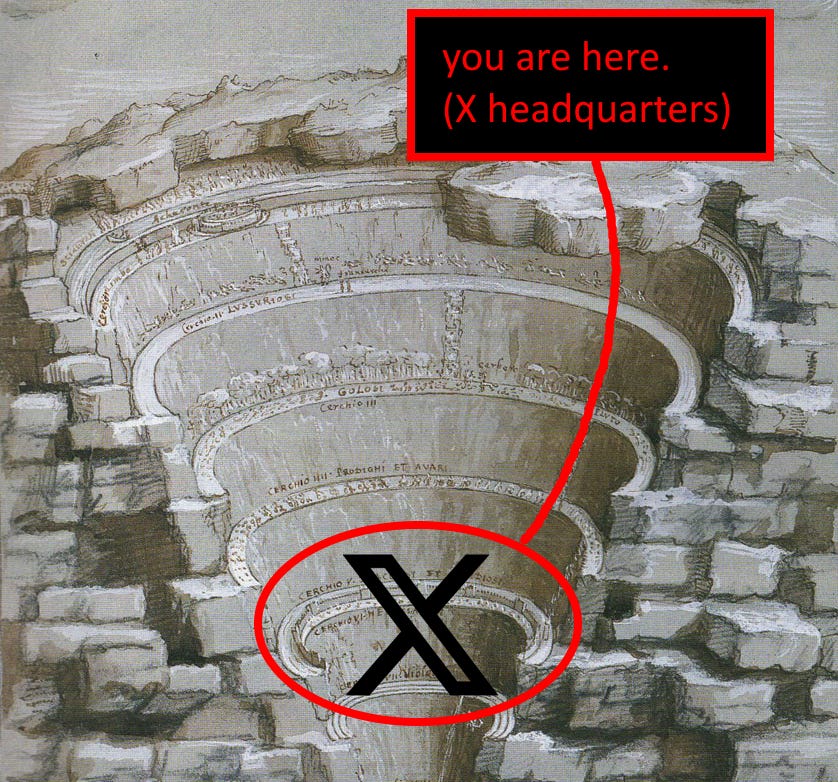
Guest writers and Smitty alike have beaten this dead horse of a topic well and truly deep into the dirt. I, however, being a pretentious know-it-all, felt that a moratorium was in order.
And so I stand here before you all with shovel in hand, prepared to exhume this rotting, bloated corpse of a conversation in the hopes another few swings against the well-shattered ribcage of this rhetorical ungulate might yield some scraps of wisdom.

Instead of focusing on figures, graphs, or any sort of competent financial evaluation of this business-forward strategy, this article’s emphasis will be on relationships between groups of people. Three groups in particular, which for ease of reference will be assigned a witty and snappy moniker.
The first group, which we will call "the Emploids'' is, to put it plainly, the people who hold true sway within the Foundation and Ava Labs. This group should be understood to be the employees and executives of the Avalanche Foundation with actual decision-making power, those who come up with the big picture business strategy of the Avalanche project and delegate to others to enact those strategies.
These are not lowly engineers, code monkeys, PR hires, social media managers, or other employees. They are team leads, managers, and executives. For ease of reference, Emin himself is within this group.
The second group is you: bagholders "the Community". Retail investors, degenerate gambling addicts, buildoooors, and independent validator node operators. These people are, in some sense, the primary userbase of the Avalanche network, some of whom have a vested financial interest in the broader success of Avalanche.
More often, this group generally holds an interest in a higher average price per AVAX token. You are more than likely in the "Community" group if you are reading this article. If you’re not: hi! I promised Smitty I’d to be nice to you.
Our third and final group, "the Suits" can then be understood as those individuals who work within and hold substantial sway in any current or potential enterprise customers or partners of the Foundation. These are people who comprise institutional forces and corporate entities that are in the process of being courted by the Foundation.
This group is not static, but relevant or high profile members of the Suits would be the executive and managerial class within Hyundai, FIFA, BlackRock, and RWA tokenization firms/entities. There are many more than provided as examples, and I’m sure more will be announced as I write this article.
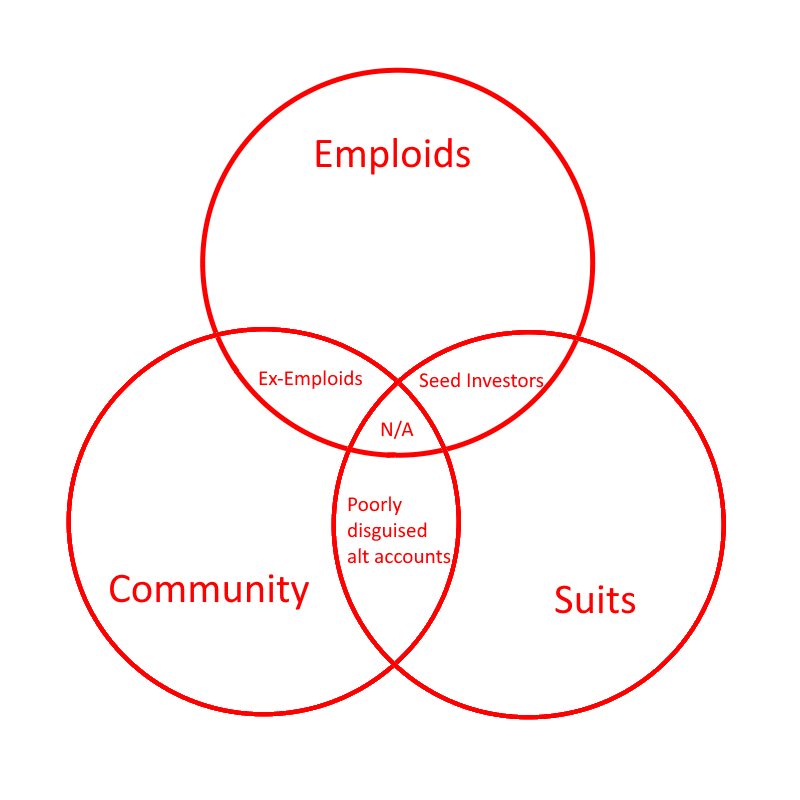
The aforementioned oversimplified narrative is as such: There exists a social gap or disconnect - pick which word feels best for you! - between the Emploids and the Community. There also exists a stronger social association or similarity between the Emploids and the Suits.
Both of these factors are relevant (in my opinion) to explain a meaningful contributing factor to the Foundation’s current business-forward strategies.
What do I mean by social gap?
So what do I even mean when I say this stuff? What does this gap look like? Why care? Should I talk to my doctor about those chest pains I’ve been having? How can I be so sure that this particular approach of diagnosing the problems that plague the Avalanche ecosystem is even relevant or correct?
Good questions, and ones I endeavour to answer with just enough of an air of legitimacy that Smitty may consider inviting me to write some more academic slop for this esteemed, luxurious column.
A social gap - for the purposes of this article - can be understood as a lack of common objective or shared perspective between two groups of people. The clearest examples of this social phenomenon can be found in simple dichotomies or groups which have clearly opposite interests. Police and criminals, a logging company’s executives and environmental activists, vegans and livestock farmers, you get the general idea.
Two groups do not necessarily need to have such clearly opposite interests for a disconnect to occur. A combination of unrelated interests, differences of ethnicity, language, faith, wealth, where an individual lives, how they speak, how they dress, etc. are all contributing factors to whether two groups of people will be more or less likely to lack a common understanding of one another.

Why does this matter? How can I be sure?
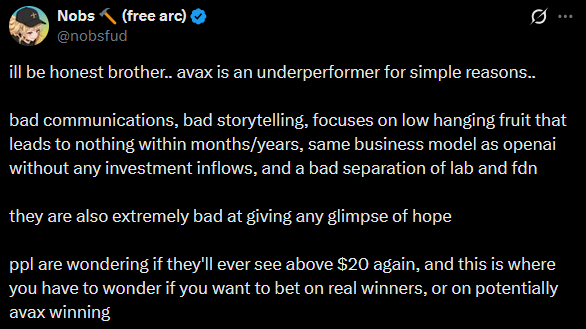
To put it bluntly, you, the bagholder, are not like them. Individuals within the Emploid group have little in common on an interpersonal level with individuals within the Community group. To use Emin again as an easy example of a member of the Emploids: Emin isn’t in your group chats. He doesn’t really get your jokes, he probably doesn’t think the memes about him being hot are very funny. (Ask Nobs!) Scandalous, I know.
The guy doesn’t even run his own Twitter account. Emin is a Princeton alum, worked at Bell Labs, was a professor at Cornell. What exactly does he have in common with the unwashed masses demanding another memecoin szn? Why exactly would he himself care?
I am emphasizing this lack of real connection or interpersonal understanding between the Emploids (Emin, in the given example) and the Community to illustrate that what is obvious from the perspective of retail investors is not necessarily what is obvious or even desirable for those atop the ivory tower.
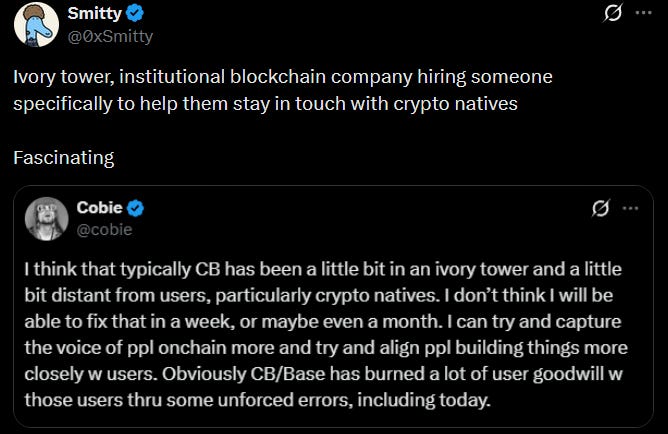
If the social dynamic between the Emploids and the Community can be described as a state of relative social disconnect, then the dynamic between the Emploids and the Suits can be comparatively described as connection. Burgeoning, not yet fully entrenched, but a connection nonetheless; there is a clear desire for that connection to continue from the perspective of the Emploids.
Those individuals who are higher-ups at FIFA, BlackRock, and Hyundai are people who share a social class with the Foundation’s higher-ups. The interests of the Emploids and the Suits are generally more aligned when compared to the interests of the Community and the Emploids, or the Community and the Suits.
The lifestyles of these higher-ups are generally comparable. These people share a social bubble together. They may have attended the same schools, might vacation in the same places, and importantly: they all understand their own position within a social hierarchy. They are like one another. They are, to be blunt once more, not like you.
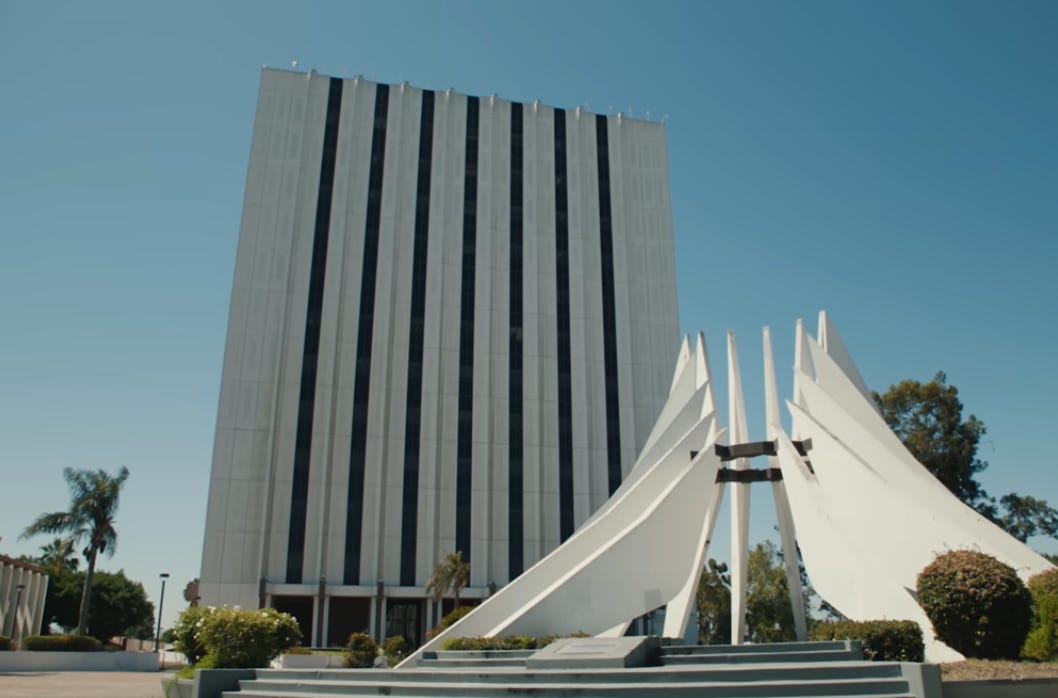
Private equity and corporate entities becoming the focus of the Foundation’s business strategy is not an accident or an occurrence of chance, or an exclusively financially motivated venture. There is a clear desire from crypto institutions to be taken seriously and be respected by those they consider to be their peers.
There is a want to be invited into important rooms where important people make important decisions about important business matters, to possess their fair share in the distribution of the power that is inherent to money, commerce, and technology. After all, it is who you know that matters most in the realm of important business.
Why should I care?
Financial evaluation of the business-forward approach is left as an exercise to the reader. What I am here to communicate is a part of the why that has gone under-discussed, and the most repeated, pleaded why I have seen usually goes something like this:
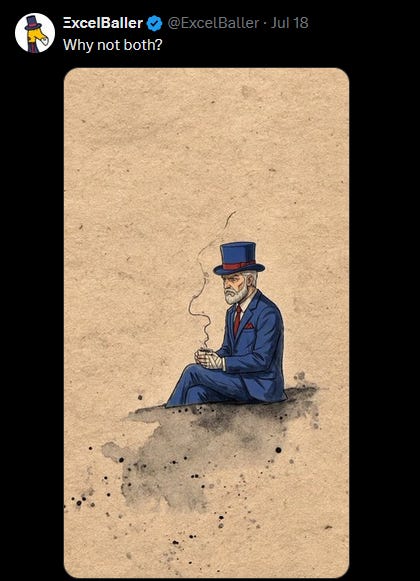
Why can the Foundation not do both? Why can’t they appeal to us and to them, work with both their actual userbase and their institutional peers?
I won’t sugarcoat it. I believe this is, among other reasons, because the Foundation would be taken less seriously by the Suits if they funded a memecoin szn, or gave grants out to Giraffe for his NFT collection or took similar community-focused actions.
To put it another way: we are now the side hoe. The Foundation is trying to get with an Ivy League baddie and cannot be seen with us in public, lest they be thought less of by her friends. It is trade-up time, and we are not good for optics.
There are of course constraints of labour hours and limited resources to be considered here too: the Foundation does not have unlimited capital expenditure. They need to focus on what they believe is their best long term survival strategy, and entwining themselves into as many tradfi and other generally institutional business dealings as possible may be their best route to achieve longevity.
I will state for the final time that I don’t know if that assessment is correct, and I’m transparently unequipped to evaluate that matter. What I do know is that while that particular goal is pursued, morale observably plummets for the rest of us, and token price falls with it.

Token price is of course the most glaring consequence of the shift in the Foundation’s approach from the perspective of the community - and the focus of many a snarky reply to Foundation business announcements on Twitter. The erosion of value for the network’s token is I feel, a somewhat predictable consequence of decreased belief in the Foundation from both community insiders and casual retail investors watching from afar.
To reiterate once more: the gap in common understanding between the Emploids and the Community contributes to the Emploids deprioritizing or becoming apathetic to the potential detrimental effects of their new way of organizing their efforts.
This apathy harms the financial prospects of the userbase, which dampens demand for retail level investment into the token, which in turn contributes to the AVAX token’s depreciation relative to the rest of the market.

While the Community may not see the harm in chucking liquidity into memecoins or giving grants to aesthetically ‘unserious’ projects, the Emploids - perhaps rightfully, from their own perspective - do see harm in such an act beyond simple capital expenditure. It would make them appear unprofessional within the social context of desiring to court institutional, governmental, or traditional financial partnerships.

Well now what?
What is to be done with this information? Unfortunately, I can’t say much that wouldn’t be an act of repetition. I can preach about the Foundation needing to communicate better, how they need to open up more to us and be honest about their intentions, but we’ve tried that dialogue before. We’re likely trying it again, right now, as this article is being written.
There are dysfunctional elements to the relationship between the Community and the Emploids, this much is irrefutable. The extent to which this dysfunction is directly responsible for worsened financial outcomes for the foundation and the userbase is a matter of debate and no sure thing. Perhaps they believe this will all be worth it, short term pain for long term gain. This is yet to be seen.
All I know is that for now, we are watching across the bar as our (hot) ex tries pickup lines on people far, far out of our league, and when we try to walk over to say hi, they act like we’ve never met.

jajajajajajajajjajajaajjajajajjajjajajajajajaajajaaajaajajajajajajjajajajajajajajajajajajajajajajajaaaajajajajaj mardetasea jajajajajjajajajaajjajaajjaja